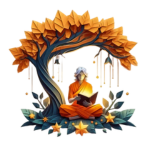
Throughout our exploration of Hindu metaphysics, we have journeyed to the furthest reaches of the cosmos. We have examined the majestic architecture of sacred spaces, the grand duality of creation, the autonomous sovereignty of the Absolute, and the infusion of divine consciousness into stone and metal. Yet, for all its cosmic grandeur, Hinduism harbors a secret that is radically, almost startlingly, intimate.
When the seeker looks up at the stars and asks, "Where is God?", the grand philosophies point to the heavens. But when the seeker closes their eyes and asks the exact same question, the Vaishnava tradition points to the center of the human chest.
This brings us to the profound metaphysical concept of Paramatma—the Supersoul. It is the realization that the Supreme is not merely an abstract force vibrating through the universe, nor is it only a sovereign ruler sitting on a celestial throne. The Divine has localized itself, taking up permanent, eternal residence within your very own heart.
Defining Paramatma: The Three Faces of the Absolute
To understand the concept of Paramatma, we must first understand the specific theological framework of Vaishnavism (the tradition within Hinduism that reveres Vishnu/Krishna as the Supreme Being).
In the core Vaishnava text, the Srimad Bhagavatam, the Absolute Truth is described as being realized in three distinct, progressive phases. You can think of it like attempting to understand the sun:
Brahman: The all-pervading, formless, infinite spiritual energy. (This is like understanding the sun by feeling its diffuse sunlight).
Paramatma: The localized, indwelling aspect of God present in every atom and every heart. (This is like understanding the sun by seeing the distinct, localized sun disk in the sky).
Bhagavan: The Supreme Personality of Godhead, possessing a divine form, qualities, and engaging in loving pastimes. (This is like traveling to the sun and meeting the sun-god face to face).
The word Paramatma is a compound of two Sanskrit words: Parama (Supreme or Highest) and Atma (Soul or Self). While you are the Atma (the individual, infinitesimal soul), God in this localized feature is the Paramatma (the Infinite Supersoul). You are a drop of the ocean; Paramatma is the entire ocean, miraculously squeezed into a drop, sitting right next to you.
The Origin: The Metaphor of the Two Birds
The metaphysical origin of the Paramatma concept is beautifully articulated in the ancient Upanishads, specifically the Mundaka and Svetasvatara Upanishads. To explain the relationship between the individual soul and the Supersoul, the ancient sages used one of the most famous and poetic metaphors in all of Eastern philosophy: The Two Birds on a Tree.
The texts describe a grand, ancient tree (which represents the material body). In this tree, there are two birds perching on the same branch.
The First Bird (The Atma): This bird is restlessly hopping from branch to branch, eating the fruits of the tree. Some fruits are incredibly sweet (representing pleasure and success), and some are terribly bitter (representing pain and suffering). This bird is fully absorbed in tasting the fruits, constantly agitated by the shifting flavors, and forgets its true nature.
The Second Bird (The Paramatma): This bird is identical in brilliance and majesty to the first, but it does not eat any of the fruits. It simply sits in profound peace, watching the first bird. It is the silent witness, waiting patiently for its friend to stop eating the bitter fruits, turn its head, and recognize the companion that has been there all along.
This metaphor brilliantly captures the Vaishnava understanding of reality. God is not distant. God is the second bird, sitting on the exact same branch of your consciousness, quietly accompanying you through the long, turbulent journey of material existence.
The Role of the Supersoul: Witness and Permitter
If the Paramatma does not interfere with the "first bird," what exactly is its function? In the Bhagavad Gita, Lord Krishna explains his localized manifestation in the heart of every living entity, describing the Supersoul as the Upadrashta (the Witness) and the Anumanta (the Permitter).
1. The Divine Witness (Sakshi)
The Paramatma is the ultimate observer. You can hide your actions from your family, your friends, and the law, but you cannot hide them from the Witness who sits within your own chest. The Supersoul records every desire, every thought, and every action. However, unlike a human judge, this observation is not done with malice or condemnation. It is the observation of a loving friend who maintains a perfect, objective record of your spiritual journey.
2. The Permitter of Karma (Anumanta)
Hinduism operates heavily on the law of Karma (cause and effect) and free will. The individual soul (Atma) has desires, but the soul itself does not have the independent power to fulfill them in the material world. It is the Paramatma that facilitates these desires. If you desire to do something good, the Supersoul supplies the memory, the knowledge, and the physical mechanism to do it. If you desire to do something harmful, the Supersoul, respecting your free will, ultimately permits the action—while ensuring you reap the karmic consequences. The Supersoul is the neutral interface between your desires and the machinery of the material universe.
3. The Inner Guru (Chaitya Guru)
In Vaishnava theology, the Paramatma is also known as the Chaitya Guru—the Guru within the heart. When a seeker begins to earnestly look for spiritual truth, they don't have to wait for an external teacher to appear magically. The Supersoul acts as the inner compass, providing intuition, flashes of insight, and guiding the sincere seeker from within until they are ready to meet an external spiritual master.
The Metaphysics of Universal Brotherhood
The concept of the Paramatma is not just a theological technicality; it is the absolute foundation of Hindu ethics and the true basis for universal brotherhood.
Often, we talk about equality based on biology, nationality, or shared human rights. But from a Vaishnava perspective, these are all temporary, material designations. The true reason you must treat every living being with reverence is that the Paramatma resides within them.
This localization is not limited to human beings. The Bhagavad Gita declares that the Supersoul is present in the heart of the saint, the criminal, the elephant, the cow, and the dog. When a true sage looks at the world, they do not just see the external, temporary bodies (the first bird). They see the blazing, radiant presence of the Supersoul (the second bird) residing equally within every single creature. Harm to another is quite literally an offense to the Supreme Lord seated within their heart.
Integrating the Supersoul into Modern Existence
How does understanding the Paramatma change the way a modern person lives their life? It shifts the spiritual search from an external conquest to an internal communion.
The End of Loneliness: The modern world is plagued by an epidemic of isolation. We feel misunderstood, unseen, and alone. The metaphysics of the Paramatma completely obliterates this illusion. You have never been alone for a single fraction of a second in millions of lifetimes. The Supreme Companion has been with you through every joy, every trauma, every success, and every failure, patiently waiting for you to turn your gaze inward.
Trusting Your Intuition: When you quiet the noisy, grasping demands of the ego (the bird eating the fruits), you begin to hear the quiet, steady voice of the Chaitya Guru. Cultivating a relationship with the Paramatma means learning to trust that deep, still intuition that guides you toward truth and compassion.
Radical Empathy: When you interact with difficult people, try to see past their agitated ego. Remind yourself: "The Supersoul is seated in their heart, just as He is in mine." This does not mean you accept toxic behavior, but it completely changes the energy of the interaction. You begin to honor the divine presence in others, even when they have forgotten it themselves.
Conclusion: The Ultimate Intimacy
The concept of the Paramatma is the crowning jewel of Vaishnava philosophy. It tells us that the Infinite, the Creator of all galaxies, the Sustainer of all life, loves the individual soul so deeply that He refuses to let us wander the universe alone.
He shrinks Himself down to the size of a thumb, takes a seat in the dark cavern of our hearts, and acts as our faithful companion, our witness, and our guide. The riddle of the Supersoul is finally this: the God you are desperately searching for out there is the very same God who is quietly, patiently looking out through your own eyes. The distance between you and the Divine is not measured in lightyears; it is simply the distance it takes for you to turn your attention inward and recognize the silent, beautiful Bird sitting right beside you.

0 Comments