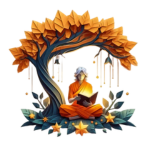
If you were to travel to the state of Uttar Pradesh in northern India today, you would eventually come across a bustling, crowded, and dusty town on the banks of the Yamuna River. To the naked eye, it looks like many other ancient Indian towns—filled with narrow alleyways, wandering cows, ringing temple bells, and the relentless hum of human activity.
But if you ask a Hindu, particularly one from the Vaishnava tradition, where you are, they will tell you that you are no longer on Earth. You have stepped into the absolute center of the spiritual universe.
You are in Vrindavana Dhama.
To understand Hinduism in its most profound, devotional depth, one must understand the mystery of the Dhama. It is not merely a geographical location with historical significance. In the Hindu metaphysical framework, Vrindavana is the literal, eternal home of the Supreme Divine (Krishna), manifesting within the physical world. It is the ultimate paradox: the infinite, uncontainable reality of God choosing to play in the dust of a finite, humble village.
Defining the 'Dhama': The Geography of Spirit
In Sanskrit, the word Dhama translates to "abode," "residence," or "light." In Western religious paradigms, heaven or the spiritual realm is often conceptualized as being "up there"—a distant, ethereal place distinct from the physical earth, attainable only after death.
Hindu metaphysics, however, proposes a radically different architecture of reality. The Dhama is not separated from our world by physical distance, but by a dimension of consciousness.
In the Vaishnava worldview, there is the spiritual realm (the eternal, unchanging reality) and the material realm (the temporary, shifting reality). A Dhama is a sacred intersection—a metaphysical portal where the spiritual realm seamlessly overlaps with the material earth.
When Krishna descended to Earth around 5,000 years ago, theology dictates that He did not leave His spiritual home behind. Instead, He brought the eternal realm of Goloka Vrindavana (the highest spiritual planet) down with Him, manifesting it on the earthly plane as Bhauma Vrindavana (earthly Vrindavana). Therefore, the town of Vrindavana is considered an exact, non-different replica of the highest heaven.
The Mystery of 'Cinmaya': The Conscious Earth
The greatest barrier to understanding Vrindavana Dhama is the human eye.
When a tourist visits Vrindavana, they see ordinary dirt, trees, water, and animals. But Hindu metaphysics teaches the principle of Cinmaya—that in the Dhama, everything is entirely made of spiritual consciousness (Sat-Chit-Ananda: Eternity, Knowledge, and Bliss).
Because the Dhama is an expansion of God’s own internal energy, it is considered non-different from God Himself.
The Dust: The dust of Vrindavana (Vraja-raja) is revered above all precious jewels. Saints have historically rolled in this dust, understanding it to be saturated with the spiritual footprints of Krishna and His devotees.
The Trees: The trees are not merely wood and leaf; they are Kalpavrikshas (wish-fulfilling trees), acting as conscious, silent witnesses to the divine pastimes.
The River: The Yamuna River is not viewed as H2O, but as a liquid goddess—the fluid embodiment of divine compassion.
The mystery is that this spiritual reality is hidden by Yoga-maya, the divine veil of illusion. The absolute perfection of the Dhama is shielded from the cynical or materialistic eye. To "see" the true Vrindavana, one does not need a map; one needs a purified heart. As the texts declare, the Dhama only reveals itself to the eyes of love.
The Metaphysics of 'Lila': The Divine Play
Why did the Supreme Absolute Truth—the creator and sustainer of infinite galaxies—choose a simple cowherd village as His highest abode? This brings us to the core of Vrindavana’s significance: the Lila (Divine Play).
In many global traditions, God is understood primarily through the lens of Aishwarya—majesty, power, awe, and reverence. God is the supreme judge, the cosmic architect, the distant monarch.
Vrindavana represents a complete paradigm shift. It is the realm of Madhurya—sweetness and profound intimacy. In Vrindavana, God hides His own divinity. Krishna does not sit on a throne wielding thunderbolts; He runs barefoot through the forest, herds cows, steals butter from the neighbors, and plays the flute.
Metaphysically, this is the ultimate expression of divine love. The Vaishnava seers realized that power creates distance. If you are constantly in awe of someone's majesty, you cannot embrace them intimately. Therefore, in Vrindavana, the Supreme Lord voluntarily subjects Himself to the love of His devotees.
He allows Himself to be tied up by His mother, Yashoda, because her parental love is stronger than His infinite power.
He wrestles with His cowherd friends, who treat Him as a total equal, completely unaware that He is the Creator of the universe.
The Lila (pastimes) of Vrindavana are not historical events that happened once and ended. In the metaphysical vision, these pastimes are eternal. They are happening right now in the spiritual dimension of the Dhama. The entire purpose of the spiritual practitioner is to purify their consciousness enough to enter into this eternal, joyful play.
Radharani and the Supremacy of Devotion
It is impossible to explore the mystery of Vrindavana without understanding its true sovereign. While Krishna is the Supreme Lord, in Vrindavana, the highest authority is Srimati Radharani.
"Vrindavana is the land where the Supreme Controller is controlled by Love."
Radharani is the personification of Hladini Shakti—God's own internal pleasure potency and the absolute zenith of pure devotion. The spiritual culture of Vrindavana revolves entirely around her. The residents of the Dhama do not pray to Krishna directly; they pray to Radharani, asking for her grace so that they may assist her in serving Krishna.
This introduces a breathtaking philosophical concept: in Vrindavana, the Devotee is greater than God. The pure, unselfish, all-consuming love of the devotee (epitomized by Radha and the milkmaids, or Gopis) is so powerful that it overwhelms the Absolute. Vrindavana is the holiest place not just because God walked there, but because it is the theater where divine love completely conquered divine majesty.
Internalizing the Dhama: Vrindavana as a State of Consciousness
While millions of pilgrims travel to the physical town of Vrindavana every year, the ultimate teaching of the Hindu mystics is that Vrindavana must be realized internally.
Because the Dhama is a manifestation of pure spiritual consciousness, it is not bound by earthly geography. The great saints taught that wherever the holy names of the Divine are chanted with pure love, and wherever a heart is completely emptied of worldly ego and filled with selfless devotion, that place instantly becomes Vrindavana.
To enter Vrindavana is to undergo a radical psychological and spiritual shift:
Shedding the Ego: Just as one must leave their shoes outside a temple, one must leave their worldly identity, pride, and material ambitions outside the Dhama.
Cultivating Simplicity: Vrindavana is the celebration of the simple, the pastoral, and the innocent. It teaches that the highest spiritual truths are not found in complex intellectual gymnastics, but in the simple, trusting heart of a cowherd.
Living in Grace: To reside in the Dhama (whether physically or mentally) is to recognize that everything is sacred. Every word is a song, every step is a dance, and every interaction is an opportunity for divine service.
The Eternal Threshold
The mystery of Vrindavana Dhama is the crowning jewel of Hindu metaphysics. It assures the human soul that the universe is not a cold, mechanical void, nor is the ultimate destination a sterile, quiet heaven.
Vrindavana stands as the eternal threshold between the finite and the infinite. It is the breathtaking promise that at the very highest pinnacle of reality, behind the grand laws of physics and the terrifying power of the cosmos, there is a serene, beautiful forest. And in that forest, the Supreme Absolute Truth is waiting, playing a flute, inviting the weary soul to finally come home and join the eternal dance of love.

0 Comments